


AdAlta is utilising the power of the i-body technology platform to develop a growing pipeline of i-bodies to treat a range of conditions, with an initial focus on treating fibrotic diseases.
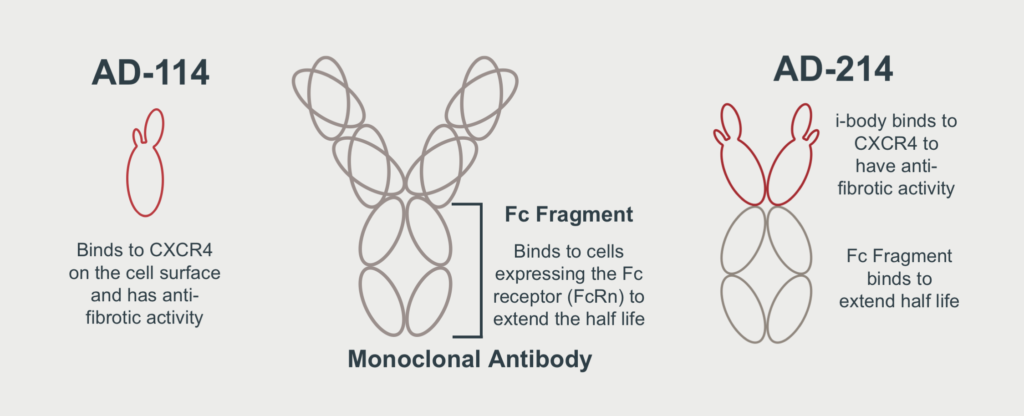
AdAlta identified an i-body that binds to the drug target, CXCR4 and demonstrates anti-fibrotic effects in several models of fibrosis. This was initially called AD-114. Following further development, AdAlta has improved the initially identified i-body through redesign as an Fc-Fusion molecule, now named AD-214. The new i-body has shown significantly enhanced activity, providing the potential application for a wider range of fibrotic diseases.
AD-214 is an Fc-Fusion protein that contains two AD-114 i-body molecules at the front end, that bind with high affinity to the human target, CXCR4. At the back end of AD-214 is the Fc Fragment or tail region of a traditional monoclonal antibody that will extend the half-life or duration of time in which the i-body will stay in the body.
When combined, the i-body and Fc Fragment create a superior next generation lead drug candidate, with improved therapeutic and commercial potential.
AdAlta’s lead i-body drug candidate AD-214 has significant anti-fibrotic effects in treating a type of fibrosis of the lung, known as idiopathic pulmonary fibrosis (IPF), and this is the initial focus. The i-body has also demonstrated its usefulness in treating fibrosis of the kidney and is being pursued as an additional opportunity for the treatment of chronic kidney disease.
AD-214 also has application in other fibrosis indications, including fibrosis diseases of the liver, skin and kidney.
The AD-214 i-body has key advantages for IPF treatment. These include:
- only targeting diseased human tissue with effects only shown on IPF tissue and no effects displayed on normal lung tissue nor any evidence of off target effects;
- being more effective than existing IPF approved drugs with greater in vitro efficacy compared to the only approved therapies Nintedanib and Pirfenidone;
- demonstrated efficacy in multiple animal models showing that the anti-CXCR4 i-body has both anti-fibrotic and anti-inflammatory effects; and
- a novel mechanism of action for fibrosis enabling a “first in class” therapy.
AD-214 i-body effective against Idiopathic Pulmonary Fibrosis (IPF)
IPF is a highly lethal and rare disease with current treatment options only demonstrating a reduction in disease progression. There is no cure. A new, more effective, and longer-lasting treatment regime using i-bodies would bring hope to hundreds of thousands of patients worldwide.
The AD-214 anti-CXCR4 i-body has completed extensive pre-clinical studies with positive in vitro (in the lab) and in vivo (in animals) data obtained. For example, in animal lung mouse disease models treated with the i-body, collagen content and inflammatory cell infiltration is substantially reduced thereby demonstrating a similar architecture to that of the normal lung.
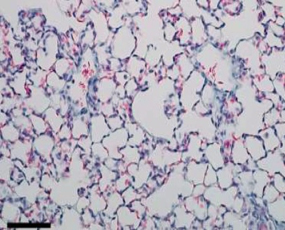
Normal lung tissue
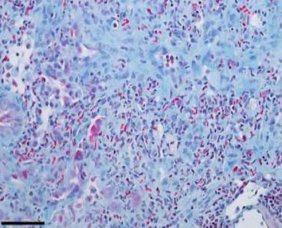
IPF lung tissue
(lung disease mouse model)
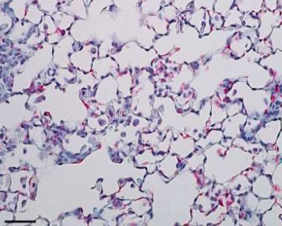
IPF lung tissue + i-body dosed for
21 days showing significant recovery
(lung disease mouse model)