Our CEO, Dr Tim Oldham was recently interviewed by Stuart Roberts of Pitt Street Research about AdAlta’s growth strategy and upcoming Phase 1 clinical trials of lead candidate, AD-214 which are due to commence in mid-2020.
In the interview, Dr Oldham speaks about how AdAlta is “the first company to use the CXCR4 axis to attack fibrosis” and how AdAlta is targeting a larger market than IPF with multiple disease indications for AD-214.
AdAlta CEO Dr Tim Oldham was recently profiled by online healthcare magazine, Insights Care.
Tim spoke about the development of the i-body platform, AdAlta’s recent achievements and the Company’s mission to develop multiple i-body based drugs against challenging to access drug targets to address substantial unmet medical needs.
An article by our Chief Scientific Officer Mick Foley reviewing the emergence of next-generation antibody like therapeutics including I-bodies was published in the latest issue of European Biopharmaceutical Review (EBR).
A video series covering the 2020 Investor Briefing, where senior leaders from AdAlta reviewed the three significant recent achievements for a lead product candidate, AD-214, and AdAlta’s strategic program.
CEO Update Investor Briefing March 2020
AdAlta Chief Executive Officer & Managing Director, Dr Tim Oldham, discusses AdAlta’s recent milestones, vision and strategic plans.
Individual Speaker Presentations
Welcome announcement
AdAlta Chair, Paul MacLeman introduces the 2020 Investor Briefing and reviews three significant recent achievements for lead product candidate, AD-214.
Vision and strategic goals
AdAlta CEO, Tim Oldham summarises the AdAlta vision and strategic plan, presents a case study illustrating what is required to realise the plan, and describes the key strategic priorities and metrics that will drive success. AdAlta’s purpose is to use its i-body platform to develop novel protein therapeutics against drug targets that have proven difficult to drug with traditional antibodies. In order to maximise the number of drugs developed from the i-body platform, AdAlta will develop an internal pipeline of drugs targeting GPCRs in fibrosis, inflammation, and oncology and enter co-development partnerships for drugs against other difficult targets and in other therapeutic areas. Near term priorities are: progress AD-214 into clinical trials and expand indications; develop an internal pipeline of 5 product candidates targeting GPCRs; develop an external pipeline through 3-5 co-development partnerships, and continue to invest in improving the i-body platform and AD-214 product.’
AD-214: pre-clinical update and PET tracer
AdAlta CSO, Mick Foley describes the significance of three significant recent achievements: winning a $1m competitive grant to develop a radio-labeled version of AD-214 to enable PET imaging in patients, significantly improving the value of our Phase I program; demonstrating efficacy of AD-214 in the gold standard animal model of Idiopathic Pulmonary Fibrosis (IPF), enabling progress into Phase I trials; and demonstrating that AD-214 binds to its target, CXCR4, for longer than the circulating half-life in blood plasma, going confidence that a weekly or longer dosing schedule may be possible and confirming the Phase I dosing schedule. Professor Foley also describes the work AdAlta is doing to extend indications for AD-214 beyond IPF.
AD-214: Phase 1 clinical strategy
AdAlta’s Vice-President Clinical Product Development, Claudia Gregorio-King discusses the two-part Phase I program for AD-214 incorporating an initial healthy volunteer cohort and then rapidly moving to patients with fibrotic interstitial lung disease (ILD) including IPF. Dr Gregorio-King also reviews potential Phase II trial size and scope.
Pipeline and partnership expansion
AdAlta CEO, Tim Oldham describes AdAlta’s sweet spot for internal projects (drugs acting on GPCRs implicated in fibrosis, inflammation or oncology where the GPCR has been validated as a disease target and previous attempts to drug the target have been unsuccessful); the describes the processes for selecting these projects, securing co-development partnerships on other targets and out-licensing internal projects such as AD-214.
Continuous i-body platform and AD-214 product improvement
AdAlta COO, Dallas Hartman, outlines strategies for continuous improvement of the i-body platform (to extend intellectual property and improve discovery efficiency and manufacturability of discovered i-bodies); and for continuous improvement of AD-214 processes and formulations to maximise the number of indications and dose levels for which the drug can be used.
Staging growth
AdAlta CEO, Tim Oldham brings the strategic themes together into a roadmap for R&D and financing for the next three years. The roadmap comprises a near term focus on maximising data generated as AD-214 moves into the clinic for the healthy volunteer part of the Phase I program, catalysing growth options; an expansion of these options during the second part of the AD-214 program through investments in i-body2.0, new indication proof of concept and initial discovery on new targets; and acceleration of growth as major investments in the internal pipeline are made and partnering efforts come to fruition.
The customisable nature of the i-body, AdAlta’s next generation antibody, has recently been demonstrated in an article published by the well-respected and peer-reviewed journal mAbs, which can be downloaded here.
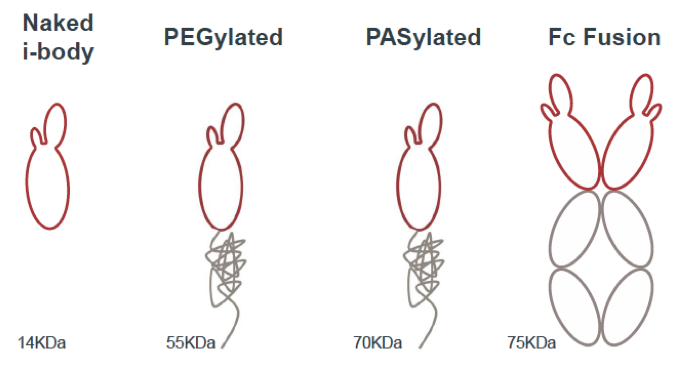
AdAlta holds a proprietary library of 20 billion i-body compounds that possess a long loop which enables access to difficult drug targets. The published paper demonstrates that the half-life of the i-body, or the time in which the i-body stays in the body, can be customised using multiple technologies (shown below). The ability to modify the half-life without affecting the binding properties of the long loop shows the flexibility of the i-body platform and increases the utility of the platform for treating a wide variety of diseases.
The customised formats of the i-body explored in the mAbs paper.
You can learn more about the i-body library and the process used to identify drug candidates from the library in an interview with AdAlta Chief Scientific Officer Dr Mick Foley. Mick has been with AdAlta since the beginning almost 12 years ago and in the video shares his greatest highlight over this time.
More information about AdAlta’s i-body technology can be found here.
If you would like to keep up to date with news on Adalta’s i-body platform and lead program, AD-214 for the treatment of Idiopathic Pulmonary Fibrosis, sign up to our subscriber list here.
There has been considerable early-stage deal activity in the Idiopathic Pulmonary Fibrosis (IPF) space over the past few days, demonstrating the significant pharma interest in the area and boding well for AdAlta, which is soon to commence its Phase 1 human trials for its lead drug to treat the lethal lung disease Idiopathic Pulmonary Fibrosis (IPF).
On July 18 global pharma group, Boehringer Ingelheim announced it had licensed a Phase 1 IPF drug from Korean biotech firm, Bridge Biotherapeutics, for a near-term payment of EU45 million and up to EU1.1 billion in milestone payments. The deal follows Bridge Biotherapeutics announcement of positive interim pharmacokinetic and safety results from the first part of its Phase 1 study in May 2019.
Meanwhile, shares in Belgo-Dutch pharmaceutical research company, Galapagos (AMS: GLPG) reached an all-time high this week after it announced on July 14 that American biotech giant,Gilead (NASDAQ: GILD) will invest US$5.1 billion to raise its stake in the company to 22 per cent and partner with Galapagos develop and commercialise its treatments for a ten-year period, including its late-stage drugs for IPF.
Gilead is providing a US$3.95 billion upfront payment and a US$1.1 billion equity investment. The company will receive an exclusive license and options rights to develop and commercialise all of Galapagos’ current and future programs in all countries outside of Europe. This includes rights to Galapagos’ late-stage candidates, GLPG1690 and GLPG1205 which are currently in a Phase 3 and Phase 2 clinical studies for the treatment of IPF, respectively.
On July 1, biopharmaceutical company,Morphic Holding (NASDAQ: MORF)announced the closing of its initial public offering (IPO) following a capital raising of US$103.5 million. Morphic is focused on discovering and developing integrin therapeutics for the treatment of IPF. The successful IPO follows Morphic and pharma giant, Abbvie (NYSE: ABBV)completing a research and development collaboration designed to advance a number of Morphic’s therapeutics for fibrosis-related indications in October 2018. Morphic received an upfront payment of US$100 million for exclusive license options on product candidates directed at multiple targets.
This strong momentum is very promising for AdAlta as the company heads to Phase 1 human trials for its lead IPF drug candidate, AD-214 in January. IPF sadly remains a debilitating and fatal condition for which there is no cure – current treatments only slow the progression of the disease.
Also promising is a number of transactions with G-protein coupled receptor (GPCR) platforms over the past week.
GPCRs are a type of drug target, and AdAlta’s AD-214 binds to the GPCR, CXCR4. The company’s i-body, with its long loop also has greater access and high specificity for these types of drug targets and provides an opportunity to selectively modulate and drug these previously undruggable targets.
Researchers estimate that between one-third and one-half of all marketed drugs act by binding to GPCRs with 25% of the top 200 selling pharmaceuticals targeting GPCRs, and that has made them a big target for drug developers.
On July 16, Sosei Heptaresinked a new deal with Roche’s (SWX: ROG) biologics unit, Genentech for a total of US$1 billion. Under the deal, the pair will seek to work on new meds that modulate GPCR targets “across a range of diseases.”
As well as its upcoming Phase 1 trial, AdAlta is also in advanced business development negotiations with potential partners for its i-body platform and is looking to complete 1-2 partnering transactions within the next six months.
These deals and an interest in the space AdAlta is working in, with AD-214 for the treatment of IPF and more broadly its i-body technology for partnering, demonstrate the significant pharma interest and potential opportunities for AdAlta.
Australian biotechnology industry association AusBiotech has released a series of case studies that represent successful partnerships and investments in the Australian life sciences. AdAlta’s lead program, AD-214, has been featured in the case study released June 2019 called Scarred for Life.
The case study introduces fibrosis, specifically Idiopathic Pulmonary Fibrosis, the indication AD-214 is looking to target, and profiles AdAlta and Pharmaxis who are both companies “working towards re-designing the landscape of fibrosis treatment”.
The full case study can be viewed below and downloaded here. Additional information about AdAlta’s lead candidate, AD-214, being developed to treat Idiopathic Pulmonary Fibrosis can be viewed here.
AdAlta has had an exciting start to 2019 and we are pleased to share with you its first Shareholder Update for 2019. The update, which can be viewed below and downloaded here, includes an update on the progress of AD-214 to the clinic, further details on the collaboration with Excellerate Bioscience and links to all AdAlta mentions in the media as well as upcoming investor events.
AdAlta CEO Sam Cobb sat down with Scott Power to provide an update to the Morgans network regarding the recent funding round and what it means for AdAlta.
You can listen to the audio recording below and the ASX announcement can be viewed here.
AdAlta CEO Sam Cobb spoke with Proactive Investors and provided insight into the recent successful completion of a $5 million Placement and covered how the funds will be used to progress both AdAlta’s lead candidate and i-body pipeline.
The interview can be viewed below and the ASX announcement regarding the placement can be viewed here.
Sam also discussed the Entitlement Offer that is currently open to all eligible shareholders. Information regarding the Entitlement Offer can be found on the Prospectus page here.